Shapes Carry Ideas
Ravish Kumar
| 21-09-2026
 · Art Team
Hello, let's get started. Most people walk past an abstract sculpture and feel a little lost.
You look at twisted metal or stacked stone and think, "Okay, but what is it supposed to be?" The trick is that abstract sculpture isn't trying to show you something. It's trying to make you feel something, and it does that entirely through shape, line, and mass.
Why form beats literal images
When an artist carves a realistic figure, you read the story instantly: a woman reaching, a man thinking. Abstract work strips that away and asks you to respond to pure geometry instead. That's why Brancusi's Bird in Space works so well, you don't see feathers or a beak, but the long, tapered bronze curve genuinely captures the sensation of upward flight. Your body feels the lift before your brain names it.
Curves invite, angles challenge
Shape language matters more than you'd expect. Gentle curves tend to feel welcoming and calm, which is exactly why Henry Moore's reclining figures use those soft, hollowed forms; they read as restful and human even though they look nothing like a person. Sharp angles do the opposite. A piece like Richard Serra's massive steel arcs, with their towering, tilted walls, creates unease and awe because the geometry pushes against your sense of balance. You lean in, you step back, you feel small.
Negative space speaks too
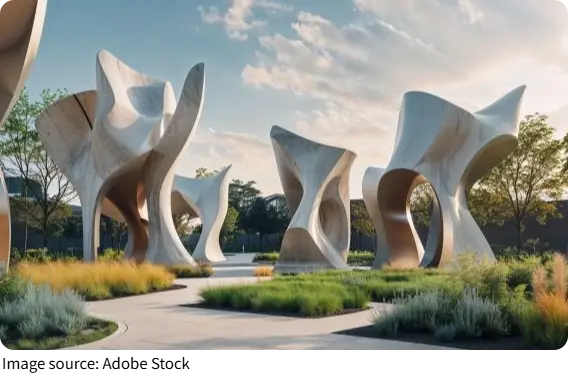
Don't just look at the solid parts. The empty gaps inside a sculpture carry as much meaning as the material itself. Barbara Hepworth was a master of this, her pierced bronze and stone pieces use holes to create tension between inside and outside, presence and absence. A single oval cut through a monolith changes the whole reading; suddenly the air becomes part of the artwork, and the sculpture feels lighter, more fragile, more human.
Scale changes the message
The same shape says different things depending on size. A small abstract piece on a pedestal feels precious, like a private thought you examine up close. Enlarge that same form up to ten feet and it becomes monumental, demanding, even intimidating. Think of Anish Kapoor's Cloud Gate in Chicago, a bean shape you could hold in your hand if it were small, but at sixty-six feet long, its mirrored surface pulls in the entire skyline and makes you part of the piece just by standing near it. The concept shifts from playful to civic.
Texture and material add layers
Shape alone does heavy lifting, but the surface tells you how to touch it mentally. Polished stainless steel feels cold, futuristic, and distant, like Kapoor's mirror finish. Rough, unpolished stone feels ancient and grounded, which is why so much of Isamu Noguchi's granite work, with its raw, pitted surfaces, connects to ideas of nature and time. Even the weight matters. A massive bronze block by Eduardo Chillida sits heavy in a plaza and whispers about permanence, while a delicate wire construction by Alexander Calder dances in the breeze and talks about play.
Trust your gut reaction
You don't need an art degree to read abstract sculpture. Your first instinct matters, and it's usually right. If a piece makes you feel anxious, that's the artist's intent working on you. If it feels peaceful, that's a success too. The next time you stand in front of an abstract work, pause for ten seconds and ask yourself one question: does this shape feel heavy or light, fast or slow, open or closed? That answer is the concept, delivered directly through form. No labels, no explanations, just the pure language of shape meeting your own body.
So next time you pass a twisted steel ribbon or a stacked stone tower, don't hunt for a hidden meaning. Feel the weight, trace the curve with your eyes, and notice where you want to stand. The sculpture is already telling you what it means. You just need to listen with your hands in your pockets.